The Split Gate Twin-Passage Barbican & Receiving Court
A broad supply-cart arch paired beside a narrow pedestrian throat, both funneling attackers into a confined stone receiving court.
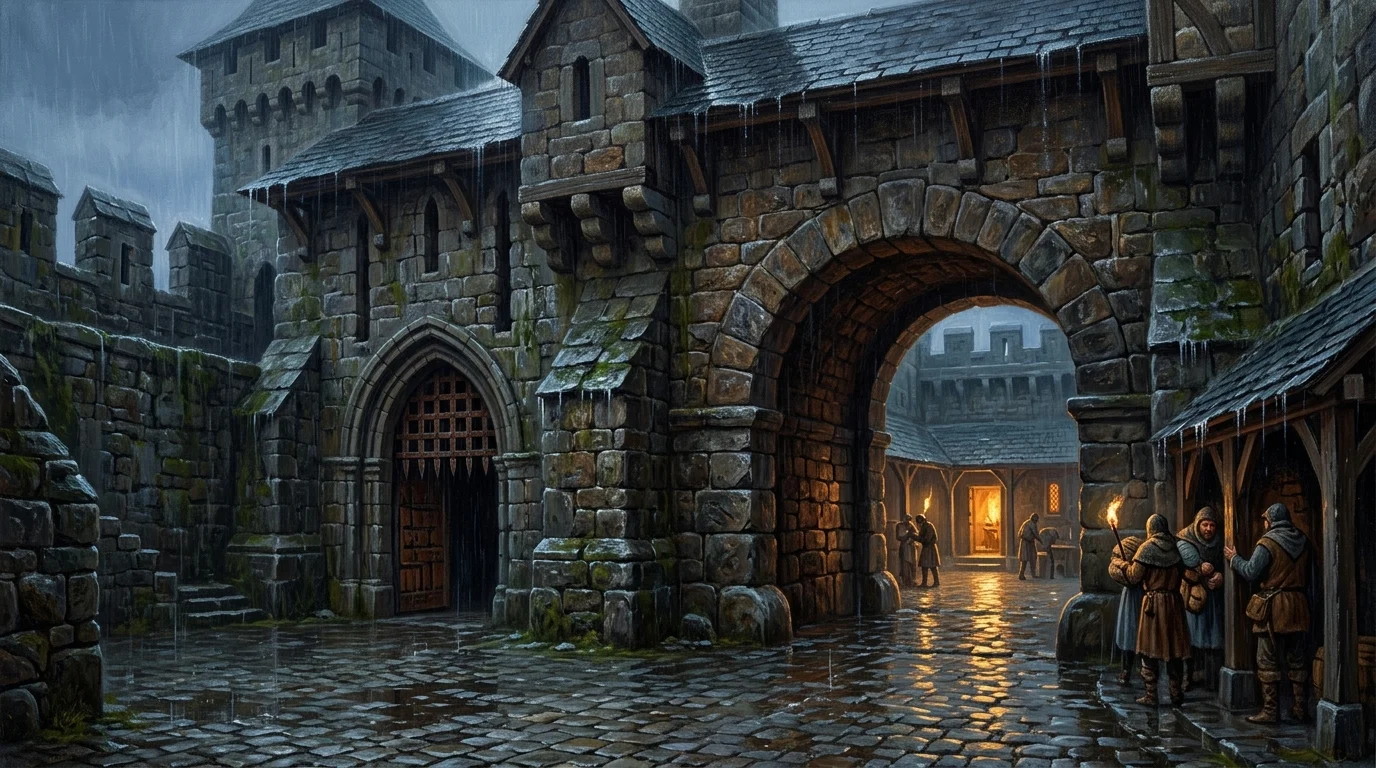
“An army that bursts the wide cart-arch still has nowhere to spread its shoulders inside the court—provided the captain on the inner postern keeps his head and drops the bar.”
Why Two Narrow Throats Defeat One Wide Charge
Commissioned under the First Ridge Pact by Master-Builder Corvin Hinge, The Split Gate rejects ceremonial palace arches designed for four-abreast cavalry parades. Instead, a thick central granite pier splits the barbican into two unequal channels:
- The Cart Passage: Wide enough for a single standardized highland supply wagon, fitted with twin oak draw-bars and wheel-check kerbs.
- The Pedestrian Passage: A low, narrow foot-tunnel forcing entrants into single file where shifted shoulder-mass becomes a liability rather than an advantage.
Both passages empty into a confined receiving court whose tight masonry corners deny any surging assault force room to fan out before inner archers and spearmen lock their flanks.
Everyday Labor as Gate Security
In peacetime, porters like Daven Barrow know the exact axle-creak, teamster face, and stopping-mark of every flour and firewood cart—meaning an unfamiliar delivery helper who halts his wagon on the wrong side of the stones (Chapters 8–9) trips immediate quiet alarm.